

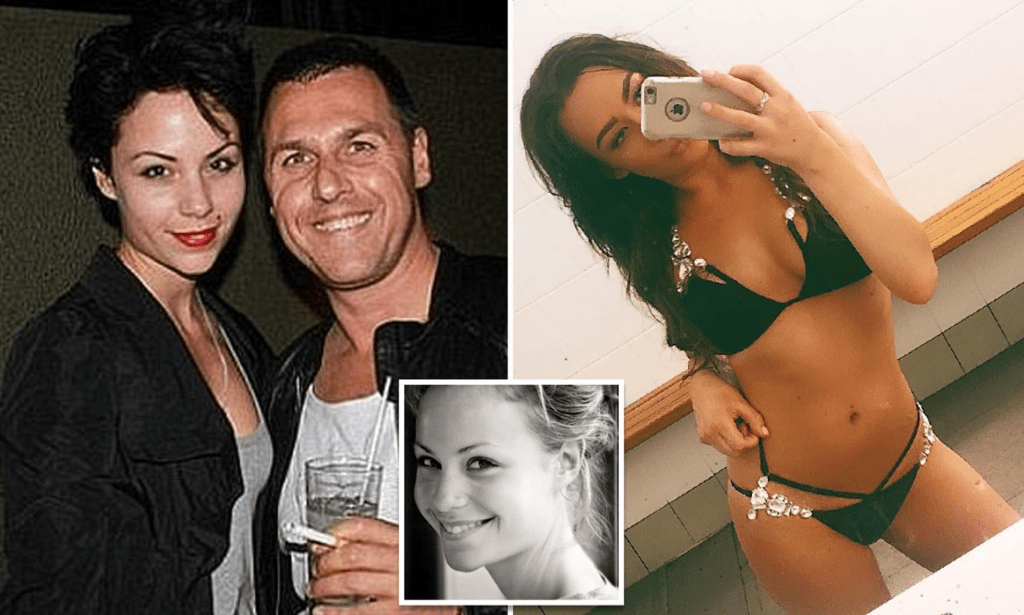
Ok guys, so you know we typically only cover missing LA women, this case we just had to cover, because it is truly just so horrible, and beyond belief that we had to cover it and shine a light of two beautiful Australian women that died at only the ages of 24 and 25, far to young. Also, it appears the highly suspicious possible murderer of these two women Phoebe and Baillee (though never been proven in a coronial inquest) is walking free in Australia, their boyfriend separated by just 8 years: Mr Antony Hampel. Because you can’t make this shit up, yo! Phoebe was NOT the first girlfriend to have died whilst dating with Antony Hampel… but he also had another girlfriend die whilst living with him in just an 8 year period….. it begs the question, what are the odds? What are the odds that two women, die whilst dating this man? Probably 1 in BILLION!
How did an avid climber, a super fit 24 year old die falling down an apartment building trash shute in Melbourne? The first and only Australian ever to have died this way. Amateur sleuths have since pointed to Handsjuk’s lover, 40-year-old Antony Hampel. The rich son of a Supreme Court Judge in Australia, who was never officially charged or suspected, despite being described as controlling.
Let’s look at the similarities of these two women:
- Both we in their early 20s, Phoebe was 24 years old when she died and Baillee was just 25 years old
- Both supposedly died of suicide, though their families think otherwise
- Both were smart educated young women
- Both did not leave suicide notes (which is very suspicious when you consider they were both very close to their families, and had extensive friendships.)
- Both had arguments with their boyfriend Antony Hampel
- Both were trying to break up with their boyfriend Antony Hampel on the day of their deaths
- Both died tragic violet deaths, not typical of suicide. Phoebe by loss of blood due to falling 12 stories down a trash shute, and Baillee was found slumped against a kitchen cupboard just hours after she broke up with her boyfriend
How Phoebe died?
Phoebe Handsjuk died by falling down the trash chute of her boyfriend’s Antony Hampel’s apartment. Drunk and on sleeping pills, Handsjuk reportedly climbed into the trash chute of her boyfriend’s apartment building and fell to her death.
Melbourne police officers found her body in the refuse room 12 stories below, where Handsjuk had fallen feet first into the garbage compactor and nearly severed her foot upon impact. While police suspected suicide, the coroner ruled Phoebe Handsjuk’s death a “freak accident.”
But others remain unconvinced. Indeed, independent experts found it “virtually impossible” for Handsjuk to have entered the chute alone — and Handsjuk’s grieving mother is convinced someone “put her in there.”
Meanwhile, somebody erased every email Phoebe Handsjuk had ever sent — and stole one of her cellphones.
News of her death on December 2, 2010, so shocked her mother, Natalie, that she sank to her knees in the gutter outside her Clifton Hill home, in Melbourne’s north, wailing: “No! No! No! It’s not true!” Phoebe’s grandfather, Lorne Campbell, a retired police detective, was phoned by his son, Matt, Phoebe’s uncle and then director of television at SBS, at about 10pm. “Dad, there is no way to say this softly, Phoebe’s dead.”
How and why she died is a disturbing tale of alleged cover-ups, police bungling, drugs and alleged murder. 14 years after Phoebe’s violent end, her family is still searching for answers. Her mother says she cannot get thoughts of her eldest child and only daughter out of her mind: a vibrant, but troubled young woman with a bright smile. Her absence has “completely shattered” her family.
“Nothing will ever be the same for us.”
The days since the death have been shrouded in sadness, frustration and anger. Despite a coroner’s ruling that Phoebe’s death was accidental and didn’t involve a third party – which ignored the advice of his own assisting counsel – question marks remain over the case.
Why were there unexplained bruises on Handsjuk’s wrists and upper arms? Why was there blood and a smashed glass in her apartment? Why were there no fingerprints on the garbage chute door?
“It is the truth we are missing here,” Natalie says. “We are being told that our daughter, granddaughter and sister put herself into this thing because she was a damaged, disturbed girl and it’s just not true. I don’t know what happened, I just feel sure she didn’t put herself down that chute, either accidentally or on purpose.”
An account of the death of Phoebe Handsjuk is explored in a new book,Into The Darkness (Scribe Publications, $35). Melbourne-based author Robin Bowles says she was inspired by Natalie’s “fierce fight for justice”.
“She’s very determined, despite the pain she has gone through. She’s still angry that there is no resolution for her family,” says Bowles.
“Phoebe was so beautiful and for her to die in that way, it is as if you are saying to the world you are nothing but garbage.” I ask Robin what she believes happened toPhoebe. “Let me say what I think didn’t happen,” she replies. “I don’t think Phoebe put herself down that chute. I think someone else was involved.”

The story of how Phoebe died is not the whole story.

Timeline of events, prior to Phoebe’s death
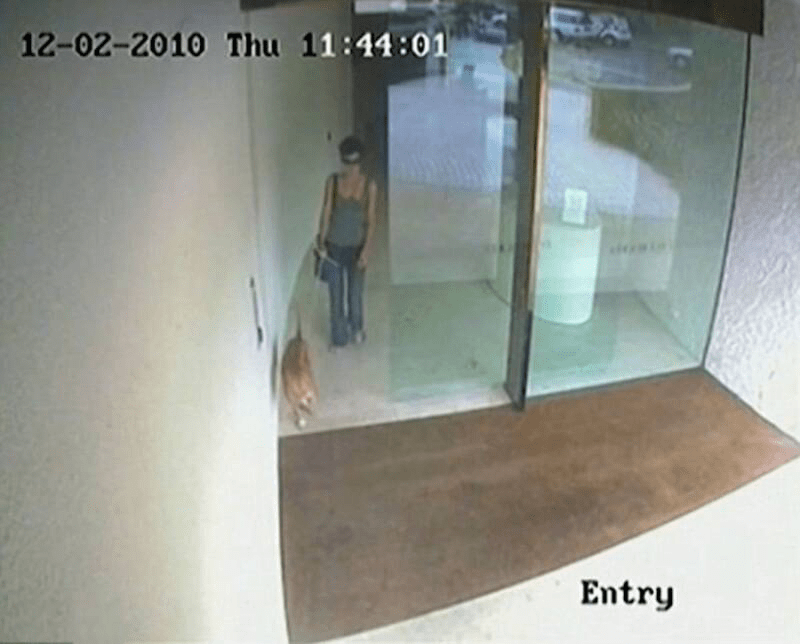
11.44am: Phoebe seen on CTV camera at the Balancea Apartments in Melbourne where she lived with Antony Hampel.
12:03pm – 7 pm Dec 2nd: Phoebe survives the trash shute fall, but bleeds to death alone in the dark of the trash shute room.
7pm: Phoebe was found by the trash shute attendant, police were called but did not check for signs of life.
Day of her death: Dec 2nd 2010
On the day of her death, Dec. 2, 2010, Phoebe Handsjuk and her father Len made plans to meet Hampel for dinner. In the meantime, Handsjuk was hanging around the apartment she shared with Hampel. She was captured on CCTV footage leaving the apartment at 11:44 a.m. following a fire alarm to walk her dog outside before returning to the 12th-floor residence. See the photo below of Phoebe walking her dog at 11.44am.
From here, only Hampel has been able to explain what happened.
Hampel claimed to have arrived home shortly after 6 p.m. and was met by shards of broken glass and blood spattered across the keyboard and computer — and Handsjuk was nowhere to be found. Yet her purse, wallet, and keys sat on the kitchen counter.
There were also two used wine glasses on the table that would never be dusted for prints.
But by the time investigators found her in a pool of her own blood next to a trolley bin in the ground floor refuse room, she had long been dead with a blood-alcohol level of 0.16 in her system — more than three times the legal limit — and one or two sleeping pills of Stillnox, a prescription sedative formally known as zolpidem.
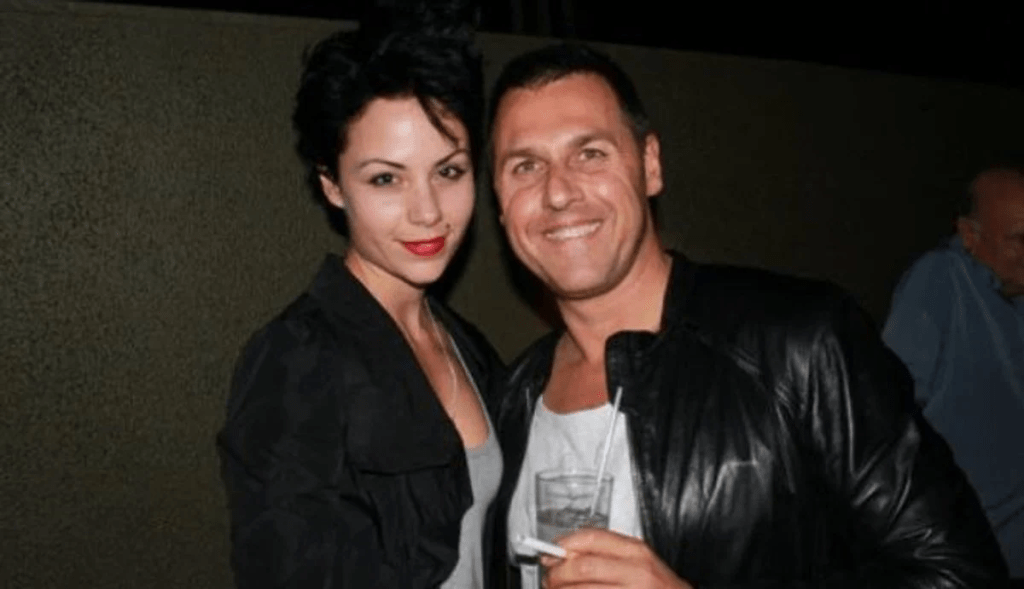
Night of Phoebe’s death
Authorities concluded that Phoebe Handsjuk entered the trash chute between 12:03 and 7 p.m. The chute was narrow and measured 14.5 by 8.6 inches. While it certainly allowed for someone her size to climb into, the coroner said she had fallen feet first with both hands by her side.
Police revealed that Handsjuk had initially survived her fall and bled to death in the dark after trying to crawl out of the garbage bin.
She had notable bruises on her arms which appeared unlikely to have stemmed from her vertical fall. While authorities concluded that Phoebe Handsjuk sleepwalked into the chute, not everyone believed it.

Phoebe Handsjuk was alone in the dark, dying on the floor of a garbage room in a luxury apartment tower, having fallen 12 storeys down the building’s main rubbish disposal chute. Her blood left a trail on the floor as she tried to crawl towards the door, dragging her broken body across the ground to try to escape the filthy room. The concierge who later found the 24-year-old’s body initially mistook her for a mannequin that someone had tossed away with the trash.
It was a bizarre way to die. Police who arrived at Balancea Apartments in Melbourne said they had never seen anything like it. Phoebe had plunged down the small rubbish chute of the upmarket St Kilda Road building. She survived the 30-metre fall but died soon after from blood loss, after the rubbish compactor blade all but severed her right foot. Phoebe fought for her life, even as it drained away, but died, faceup, by the rubbish room door.
“Phoebe’s family believe and I believe, there are people out there who know a bit more, who she may have come across or was involved with in that final week of her life, who, for whatever reason, weren’t questioned by police… I think there’ll be one or two more twists or turns before too long,” he said cryptically.

On December 2nd, 2010, 24-year-old Phoebe fell 12 stories down the garbage chute accessible from her apartment floor, before landing in a wheelie bin at the bottom. We know she survived, because there was blood spread across the room that indicated that the young woman tried to crawl towards an exit before succumbing to her injuries.
She was found at 7pm by the complex’s concierge, and from that very night, police were treating her death as suicide.
As Baker explained, “ambulance officers didn’t check for signs of life, which I found troubling… but the police had already made the assessment that she was gone”.
Within days, the Homicide Squad had confirmed Phoebe’s death as a suicide, which Baker says is something he had “never seen happen so quickly in any other high profile death in a suspicious circumstance involving a woman in a de facto or intimate partner setting”.
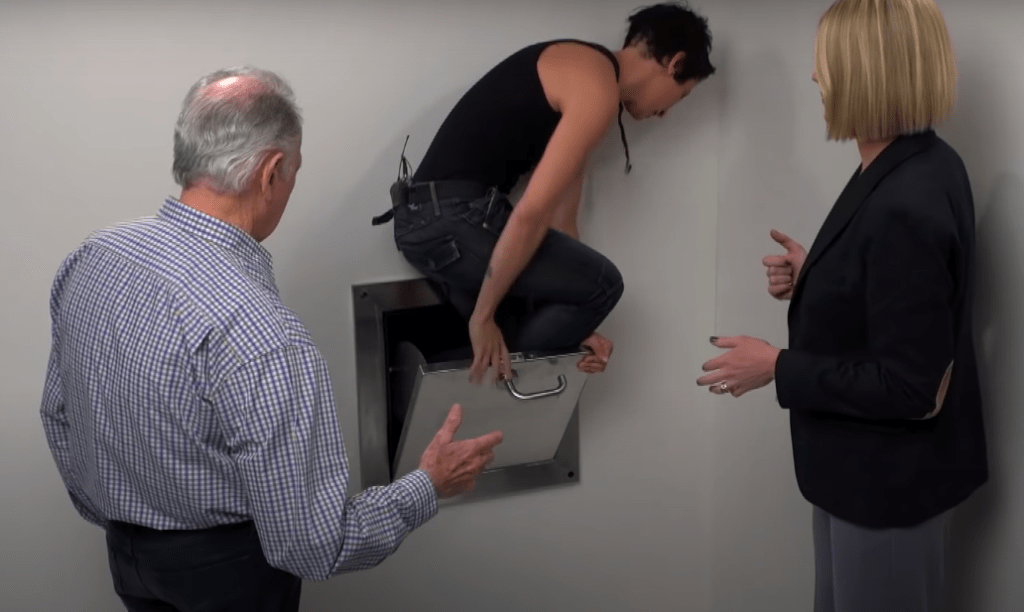
The photo below is an attempt to recreate Phoebe Handsjuk’s demise by Phoebe’s grandfather, retired police detective. “Right from the start,” he said, “I believed she had been murdered.”
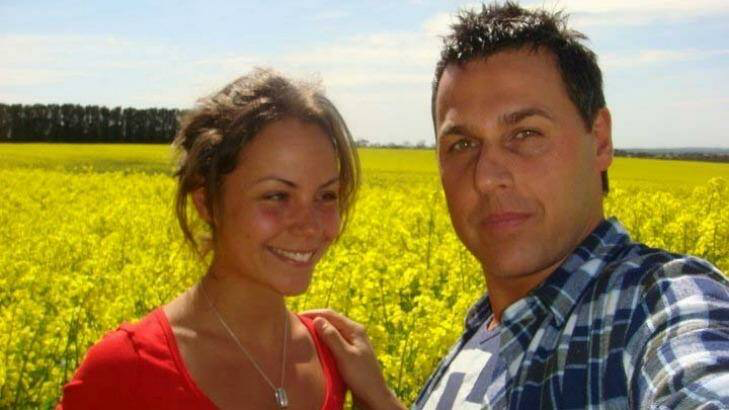
There was broken glass on the floor, a ripped cushion and blood found on Phoebe’s laptop.
The scene, however, was never properly scrutinised. Computers weren’t seized, glasses on the kitchen bench weren’t tested for fingerprints or their contents, and no CCTV was taken by authorities from around the building from the hours around her death. The CCTV hard drive later went missing.
Baker was contacted by Phoebe’s devastated family as they fought to have Phoebe’s death investigated by a Coronial Inquiry, which — after some pressure from the media — it eventually was. But that finding only led to further anger and disappointment.
In 2013, Coroner Peter White ruled that Pheobe’s death was ‘accidental,’ going against his own Counsel Assisting’s recommendation of an open finding based on there being not enough evidence to rule in favour of suicide, accidental death or foul play.
Phoebe Handsjuk’s grandfather Lorne Campbell, a retired police detective, received the dreadful news on the phone at 10 p.m. the day she was found. Arriving at the scene, he was immediately convinced of only one thing.
After five days of leaving the CCTV footage and all of Handsjuk’s computers and devices behind, homicide detectives concluded there had been no foul play. They theorized that Handsjuk had cut her hand and climbed into the chute while trying to dispose of the broken glass.
Look how TINY that trash shute is!!!!
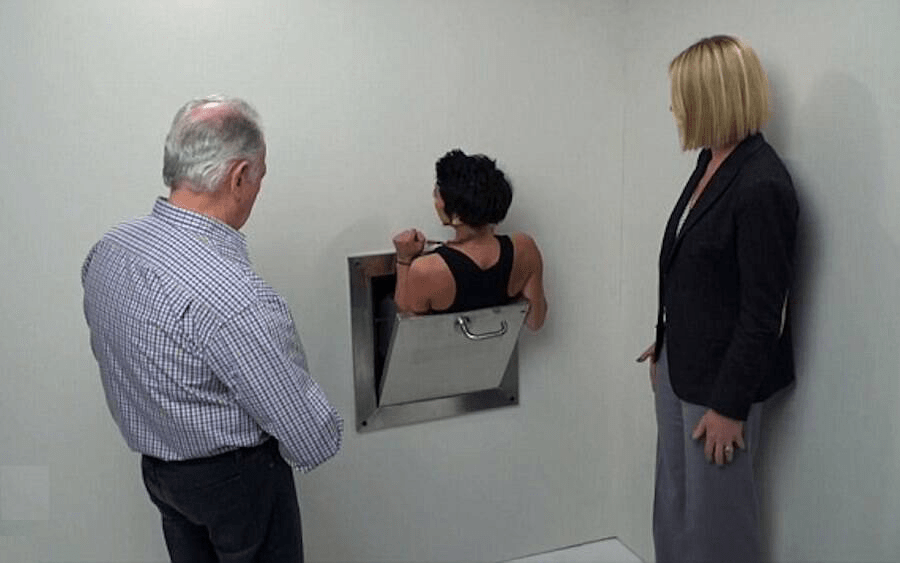
“They just missed so much,” said Campbell. Indeed, he noted that in addition to the wine glasses, samples of large shoe prints leading from the apartment were ignored. He tried recreating the climb itself with a chute replica and Handsjuk’s friends as test subjects. Sober and athletic, they found it extremely difficult. Retired Victoria Police Detective Rowland Legg agreed.
“One of the major problems apart from the dimension is that the door comes up against your lower back and jams you in, so trying to maneuver yourself is then not helped by the fact there is nothing to grip onto,” said Legg. “And … whatever Phoebe had in her system at the time would have made it even more difficult.”
Phoebe’s body was found with her jeans around her knees, another strange detail that wasn’t properly scrutinsed.
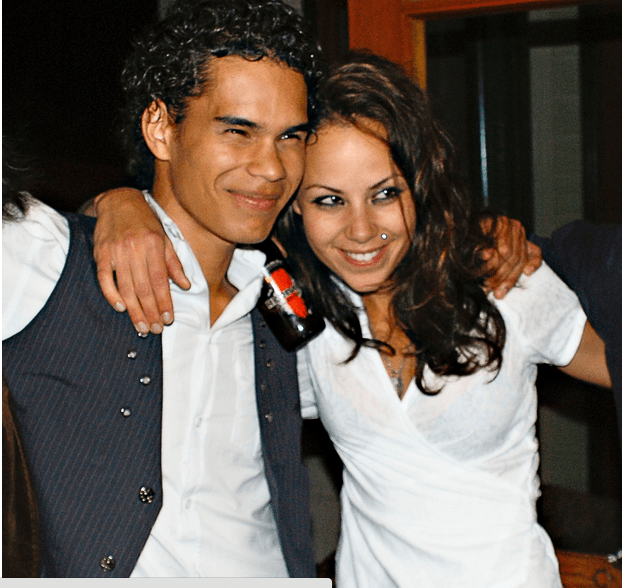
“Going down, I don’t know how that that might happen, you’re more likely to have your pants sort of pull up as you’re going down,” Baker noted.
Other inconsistencies include bruising on her arms consistent with grip marks, which suggest she may have been grabbed prior to her fall. This evidence wasn’t picked up until the detective completing the brief of evidence for the Coroner looked at the medical examination photos of Phoebe’s body.
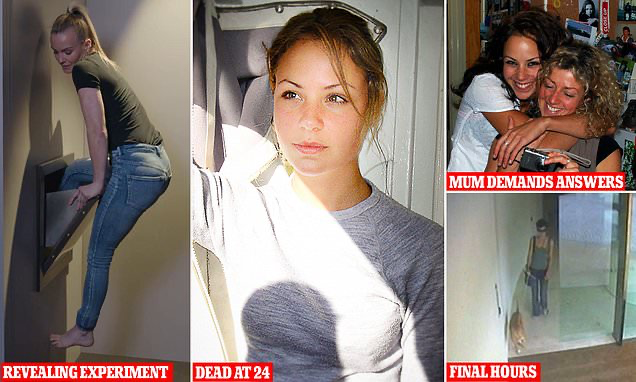
Phoebe’s final week.
Phoebe and her boyfriend of 18 months had broken up four times in the six weeks before her death. According to Phoebe’s pyschologist, who spoke to her in the days before her death, her mood was extremely low.
But neither the psychologist or Phoebe’s family, who she was very close too, say she was suicidal.
She did have a Skype call with her mother Natalie Handsjuk on the Sunday before her death, who asked her how things were going after reconciling with Hampel.
Natalie told Baker that Phoebe had silenced the conversation by putting a finger to her lips, indicating he was in the other room.
The day before her death, Phoebe sent a strange text to her family and Hampel that read:
“HI FAMILY, I am in bed about to sleep and when I WAKE I will transform into the most incredible human bein [sic] you’ve ever seen! … (not) I will go to hospital. It’s safer there and I hear the special tonight is tomato soup … Delicious! Nutritious! I love you all very much but not enough to send an individual text. Sorry about that but time is sleep and I must b on my way … Merrily, merrily, merrily. Life is but a dream. Xo.”
The text felt “off” to her family, and after struggling to reach her, they were reassured by Hampel that she was fine, and was sleeping off a ‘bender’ from the night before.

Hampel’s father was a Supreme Court justice, and his stepmother was a Country Court judge, which prompted Baker and his podcast to question if they were the reason Phoebe’s case wasn’t investigated more thoroughly.
“I guess it’s human nature. People often, rightly or wrongly, tread a bit lightly around powerful people. You’ve got to wonder whether or not that happened here, because the point of doing this podcast was to actually put the justice system on display and ask the question, ‘Did it give Phoebe a fair go?’ I think it failed,” he told True Crime Conversations.
In 2013, a full inquest into Phoebe Handsjuk’s death was held after her mother raised $50,000 to cover the proceedings. Hampel’s attorney objected to the notion that Handsjuk was murdered, with Coroner Peter White testifying that she sleepwalked into the chute herself.
On Dec. 10, 2014, the inquest concluded in Hampel’s favor.
While Campbell believes that Phoebe Handsjuk’s death may have had something to do with the Melbourne drug trade, there’s insufficient evidence of this. Others are far more suspicious of Hampel himself, who ate and had a beer after noting broken glass and blood in his home.
Linley Godfrey, who had known Phoebe and Hampel before they started dating, didn’t expect the relationship to last. “I thought Phoebe was just going to shag him and flick him,” he says.
They went out for five months before Phoebe moved into his St Kilda Road apartment in October 2009. They seemed an odd couple. She was a homegirl, dressed in a singlet and jeans. He was always at social events. In 2013, when the Coroner’s findings were initially handed down, the state’s narrow appeal grounds made it near-impossible to challenge the decision, with substantial costs to pay if they failed.
As Baker’s podcast and investigation caused uproar in 2016, Victorian Attorney-General Martin Pakula asked the Coronial Council to review the rights to appeal “against the evidence or weight of evidence”.
The Victorian Government passed laws allowing this to happen in June 2018, and extended the appeal window from 28 days to three months.
As of 2024, the finding in Phoebe’s death remains as ‘accidental’ in the eyes of the law, and it will remain that way unless new evidence or facts emerge in the case.
She loved painting and creative clutter. He “wanted the apartment to look like nobody lived there”, according to his cleaner. Phoebe left the salon early one day, stressed about cleaning an ink stain from the apartment’s carpet before Hampel came home. She told psychologist Joanna Young, who was concerned Phoebe was potentially suicidal, that Antony put her down and made her feel stupid. Hampel told the inquest she was self-destructive and “struggled every day to do the simplest things”. Natalie says her daughter drank to overcome her social insecurities around Hampel and his friends, who were older, attractive and wealthy. She once calledher mum in distress. “She said: ‘Mum, I just don’t know what to do. I love Ant but it’s not working.’”
Phoebe walked out on Hampel four times in the six weeks before she died,only for him to convince her to return. “He was a very controlling person and he was a friend of mine,” says Godfrey. “I felt sorry for him because I feel he was in love with her and he was losing her.”
I ask Godfrey what he thinks is the truth behind Phoebe’s death. He takes a deep breath, “I don’t know,” he says.
“Phoebe loved life. Not a day goes by when I don’t think of her” Linley Godfrey
“Phoebe loved life,” says Lorne Campbell. “Not a day goes by when I don’t think of her and the horror of it,” he says. He was planning to see her on his 70th birthday in December 2010. Instead, he went to see the garbage chute at her apartment. He was staggered by how small the disposal hatch was; it measured only 37cm by 22cm and was more than a metre above the floor. There’s no way Phoebe could have climbed inside in her condition, he says. She was uncoordinated after only two drinks, but toxicology reports revealed she had taken the prescription sedative zolpidem, known as Stilnox, and had a blood-alcohol level of 0.16 – more than three times the legal driving limit.
Then there were no fingerprints on the chute door or steel surrounds, which appeared to have been wiped clean, says Campbell. “Right from the start, I believed she had been murdered.”
Campbell was a police officer for more than 30 years and was like a “dog with a bone” when it came to catching criminals. So when homicide detectives decided within five days that Phoebe had likely committed suicide, he started his own investigation.
To see if Phoebe could have climbed into the chute, he attached safety harnesses to two of her friends and tested them on a replica. They were sober and athletic, but could only climb in with great difficulty.
He also pointed out faults in the police investigation, such as the failure to examine CCTV footage, the failure to seize computers in the apartment or to test two drinking glasses left in the kitchen.
Police also failed to take samples of mysterious, large shoe prints leading away from the apartment. “They just missed so much,” he says.
A full inquest into Phoebe’s death was held in 2013, despite the objections of Hampel’s barrister, who said there was no basis for believing she had been murdered. Natalie raised about $50,000, including money from donations and her own savings, to cover her family’s legal costs.
Hampel told the inquest that the night before her death, Phoebe was in “recovery mode” from a heavy drinking session. She was still in bed when he left for work the next morning, he says. The last time Phoebe was seen alive in public was just before midday, on the lobby’s CCTV cameras, during a fire evacuation. She was stumbling slightly as she held Antony’s bull terrier Yoshi on a leash.
The coroner subsequently ruled that she entered the chute sometime between 12.03pm and about 7pm, only minutes before her body was found by the concierge. When Hampel returned home that night just after 6pm, he told the inquest that the apartment was empty. He said he found Phoebe’s bag, keys and wallet on the kitchen counter, and broken glass on the floor. There was blood on the mouse and keyboard of the computer they shared.
“I was becoming very concerned at that point,” he said. He used the computer, had a beer and ordered takeaway. When the deliveryman arrived, he mentioned there were police in the downstairs foyer.
“I was becoming very concerned at that point”Boyfriend Anthony Hampel
Hampel went downstairs and was told that a body had been found. When asked at the inquest whether he had any involvement in Phoebe’s death, he said: “Absolutely not.”
Coroner Peter White agreed. On December 10, 2014, four years and eight days after Phoebe died, he found she had climbed unassisted into the rubbish chute while in a “sleepwalking state” and fell down feet first, due to consumption of alcohol and Stilnox.
Her “penchant for climbing” likely caused her to enter the chute without having any intention to cause herself harm, he said. He ruled out suicide or the involvement of any third party and complied with a request from Hampel’s lawyer to exonerate his client.
A model who’s the same age and same build as Ms Handsjuk then tried to lift herself into the chute multiple times but was unsuccessful.
Eventually, with her arms directly over her head, the model could wriggle her way through the 22cm latch opening.
“One of the major problems apart from the dimensions is that the door comes up against your lower back and jams you in,” Rowland Legg, a retired Victoria Police Detective, told the program.
“Trying to manoeuvre yourself is then not helped by the fact there is nothing to grip onto.”

Channel 9’s reconstruction of the chute death conclusion reached by the coroner.
Another fact to cast doubt on the theory is that investigators originally determined Ms Handsjuk had plunged down the chute with her hands at her side, given the injuries she sustained.
The experiment showed just how hard that would be.
“And on top of that whatever Phoebe had in her system at the time would have made it even more difficult,” Mr Legg said.
The coroner found that Ms Handsjuk would’ve been in a trancelike state from consuming significant amount of alcohol and the potent sleeping pill Stilnox.
Tests showed her blood alcohol content was three times the legal limit.

Police have never regarded Hampel as a suspect and the author of this article does not suggest he was involved in Phoebe’s death. However….the odds of two young girls less than 25 years of age, who dated the same man, who was significantly older to them both, who both had tried to break up with this man several times over, and on the night of both of their deaths….does make you wonder, what do these two cases have in common? Surely there is more to their stories than meets the eye, that deserves further investigation. For example were these two women victims of domestic abuse?
The outcome of the inquest was a blow to Phoebe’s family, especially as the coroner ignored submissions from his assisting counsel, Deborah Siemensma, a copy of which was obtained by The Sunday Age.
Siemensma felt the combination of evidence – including unexplained bruises to Phoebe’s upper arms, the blood in the apartment and the lack of fingerprints on the chute – and the inadequacies of the initial police investigation did “not enable a positive finding to be made on the balance of probabilities as to the involvement of Mr Hampel” or another third party.
Siemensma continued, “That is not to say he had any involvement, but rather, there is an inability to ‘exculpate’ on the balance of probabilities,” adding “aspects of Mr Hampel’s evidence that were unsatisfactory”.
Phoebe’s family hoped to take their case to the Supreme Court, but ran out of money. They also received legal advice that any appeal of the coroner’s finding was unlikely to succeed, as Victorian law only allows such appeals on errors of law not fact.
“Natural justice is the only thing we’re going to get out of this”Phoebe’s mother, Natalie
Natalie says the legal system has failed those who need it most. “Natural justice is now the only thing we’re going to get out of this. Karma will come to whoever has been involved, we just have to be patient.”
In the meantime, she mourns the loss of her Tiger Cub at her home at Mallacoota, East Gippsland, a place much visited by her family before she moved there to escape Melbourne and its painful memories.
Phoebe’s artwork and photographs cover the walls. “I don’t think I have properly accepted that she is not here,” she says. “Every now and then I will watch a lovely exchange between a mother and daughter or get news that one of Phoebe’s friends is pregnant, and it makes it all fresh again.”
A short walk from Natalie’s cottage is a seat with an ocean view, where she often discussed her daughter’s future with her. Phoebe planned to move to Mallacoota to work and save for a trip to India. She wanted to do aid work. Natalie now sits there alone, pondering why her daughter died.
Perhaps Phoebe got in a fight with a visitor to the apartment, she says. “I think she may have said something to upset someone, I don’t know who but I think that she’s been injured and whoever was involved has panicked and tried to get rid of her.”
Watching a kite hovering in the sky above reminds her of Phoebe. “I have got a piece of her artworkmwith the words ‘Let. Me. Fly’, and I just hope she’s flying,” she says. “She just wanted to be loved and to help people. I hope that she’s at peace and getting ready for her next journey.”
Campbell still hopes that someone will come forward with the truth. He thinks his granddaughter’s death may be related to Melbourne’s drugs trade.
Maybe Phoebe knew too much or offended the wrong people, he muses. “I’m hopeful something shakes out of this eventually. It is such a waste of life.”


Hampel’s second girlfriend Baillee Schneider also died????
Hampel went on to date 25-year-old model Baillee Schneider in 2018 — only for her to die with a gold cord wrapped around her neck mere hours after the two broke up. She was discovered at her family home in Moonee Ponds. Her death was ruled a suicide by asphyxiation, but her parents insist this is impossible.
Hampel, meanwhile, has since moved out of his apartment — and is happily married. But for the Handsjuks, moving on from their loss remains a lifelong struggle.
How did Baillee meet Antony?
25-year-old Baillee Petra Schneider grew up in Queensland, Australia. At the age of 19, she moved to Melbourne where she enrolled in a Dental Assistant program and worked part-time as a fashion merchandiser.
Baillee’s stunning good looks brought her modeling gigs and an entrance into the nightclub scene, where she was introduced to cocaine and binge drinking. Eventually, she became riddled with anxiety and was prescribed Zoloft, an anti-depressant.
In 2017, Baillee’s parents moved to Melbourne to help her get her life back on track. She moved in with them, enrolled in an Applied Medical Sciences program, and took a new job at a dental practice.
In early 2018, Baillee returned home from a short modeling gig in Bali and announced she was dating then-51-year-old Antony Hampel, a live events promoter.

While there were “unusual aspects” to how the 25-year-old’s body was found, coronial investigators found it was unlikely an intruder was involved. Baillee Schneider, 25, was found unconscious by her parents with a gold cord tied around her neck at their home in Moonee Ponds in Melbourne’s inner-north on June 24, 2018.
In the hours leading up to her death she had been in close communication with well-known Melbourne 51-year-old events promoter Antony Hampel and had a row with him the night before at a barbecue.
The dental assistant had told her mother that morning she had broken up with her older socialite boyfriend.
One of Mr Hampel’s previous partners Pheobe Handsjuk died in 2010 at the age of 24 when she fell feet first down the garbage chute of her high-rise apartment building in what was deemed by a coroner to be an accident.
Daily Mail Australia does not suggest Mr Hampel was involved in either of the women’s deaths.
Ms Schneider’s death was initially ruled a suicide but referred to a homicide squad for further review in December.
Deputy Coroner Caitlin English on Tuesday though said the review had established her cause of death in her family home was self-inflicted asphyxiation.
Ms English accepted investigators had ‘not identified any suspicious circumstances’ relating to the death. ‘I am satisfied that Ms Schneider while affected by drugs, alcohol, prescription medication and cocaine, upset by relationship difficulties, made an impulsive decision to end her own life,’ Ms English found.
Ms Schneider had split-up with the 51-year-old because ‘their worlds were just too different’, the coroner was told.
Ms Schneider’s parents Cameron and Sabine had pushed for a deeper investigation into their daughter’s death, with Mr Schneider saying last year ‘it was hard to see how’ the 25-year-old could have killed herself.
He said there was no suicide note, no obvious place to hang a rope and they are still baffled by her decision to take out a life insurance policy three weeks beforehand.

There was no sign of forced entry or a fight inside the house, according to police who attended the scene. ‘None of us can understand how she could have done this to herself,’ Mr Schneider told The Age at the time.
‘It’s not impossible but it is hard to see how.
‘Yes we want resolution but not at the expense of the truth. So it is encouraging police and the Coroner are being thorough.’
At the time of her death Ms Schneider had been dating Mr Hampel for about nine months.
He is believed to have been one of the final people Ms Schneider spoke to before her death.
Their row at the barbecue was still weighing on Ms Schneider’s mind the morning after, and while her parents were out she had poured herself a glass of wine and smoked a cigarette. A toxicology report also revealed traces of cocaine in her blood.
In the months leading up to her death, Ms Schneider began working at strip clubs in Melbourne and increasingly hid more of her life from her parents.
Included in this was her relationship with Mr Hampel, who she rarely mentioned or posted about on social media.

A toxicology report showed Ms Schneider was three times over the legal limit for driving and there were traces of cocaine in her blood. The young model and dental assistant, who broke up with Mr Hampel, then 51, that morning, didn’t leave a suicide note.
“I am satisfied that Ms Schneider while affected by drugs, alcohol, prescription medication and cocaine, upset by relationship difficulties, made an impulsive decision to end her own life,” Ms English found on Tuesday.
How did Phoebe meet Antony?
When she was 23, Phoebe Handsjuk worked reception at the Linley Godfrey hair salon in South Yarra. Around this time she met 39-year-old Antony Hampel, who was one of her clients. A handsome events promoter, his father was Supreme Court Judge George Hampel and stepmother County Court Judge Felicity Hampel.
While her boss Linley Godfrey thought, “Phoebe was just going to shag him and flick him,” she wound up dating Hampel for five months and moved into his Balancea Apartment on St. Kilda Road in October 2009.
Over the next 14 months, Handsjuk began to drink heavily and told her psychiatrist Joanna Young that Hampel was verbally abusive. She left him four times in the six weeks before her death. According to Godfrey, Hampel always managed to lure her back. Tragically, Phoebe Handsjuk’s fourth return would be her last.
Who was Phoebe?
Born on May 9, 1986, in Melbourne, Australia, Phoebe Handsjuk was drawn to the great outdoors since her childhood. She was an older sister to two brothers, Tom and Nikolai. Her father Len was a psychiatrist, and they altogether formed a happy family in the Richmond suburbs. She was born on May 9, 1986, the Chinese year of the tiger, to Natalie and Len, a psychiatrist, and later sister to brothers Tom and Nikolai.
Natalie called her only daughter her Tiger Cub. They grew up on a big block in Richmond, in Melbourne’s inner-east, in a rambling house with a slate roof that Phoebe liked to climb on top of and stare at the sky. She enjoyed physical challenges, including rock climbing and hiking. Her teacher at the nearby Steiner school said she had never met such a strong child.
At 14, Phoebe was “quite hormonal, romantic, intuitive and very sensitive”, her grandmother Jeanette Campbell told the inquest into her death.
At age 15, she started hanging out with the “wrong crowd”, experimenting with drugs like alcohol, speed, ecstasy and marijuana. She ran away from home and lived in a squat in the city’s north for eight weeks, with an ex-prisoner, his partner and their baby. After returning home, she began taking antidepressants to curb her mood swings.
By age 16, as Bowles reveals in her book, Phoebe was in a relationship with a teacher who was almost twice her age – starting a pattern for falling in love with older men. At the same time, she was struggling to deal with the decline of her parents’ marriage.
Natalie says it was her intolerance for alcohol, in particular, that was responsible for driving her off course.
“There are people who can’t cope with it and she was one of them,” she says. “She was too sensitive, she was affected too quickly and easily.” At 15, however, Handsjuk began drinking and experimenting with drugs. She even ran off and lived with an ex-convict and his child for eight weeks. Returning home, she was prescribed antidepressants before starting a relationship with a local teacher twice her age.
Former boyfriend Antony Hampel referred to Phoebe’s drinking problem as “the monster”. They met in 2009, when he was almost 40 and she was 23 and working as the receptionist at Linley Godfrey’s hair salon in South Yarra, where Hampel had a regular cut. Hamper is the son of retired Supreme Court Judge George Hampel, QC, and stepson of serving County Court judge Felicity Hampel, SC. He is handsome, smart and an events promoter, with money and glamorous friends.
The author of this article does not suggest in any way that Antony Hampel is the murderer of Phoebe Handsjuk or Baillee Schneider, but does have lots of questions about his involvement. However without more incriminating evidence coming to light or further legal investigations being undertaken, which we hope will unearth the truth and for justice to prevail.
Sources:
https://allthatsinteresting.com/phoebe-handsjuk
https://www.mamamia.com.au/phoebe-handsjuk-death/
https://www.truecrimecreepers.com


Leave a comment